The challenge for… the Liberal Democrats
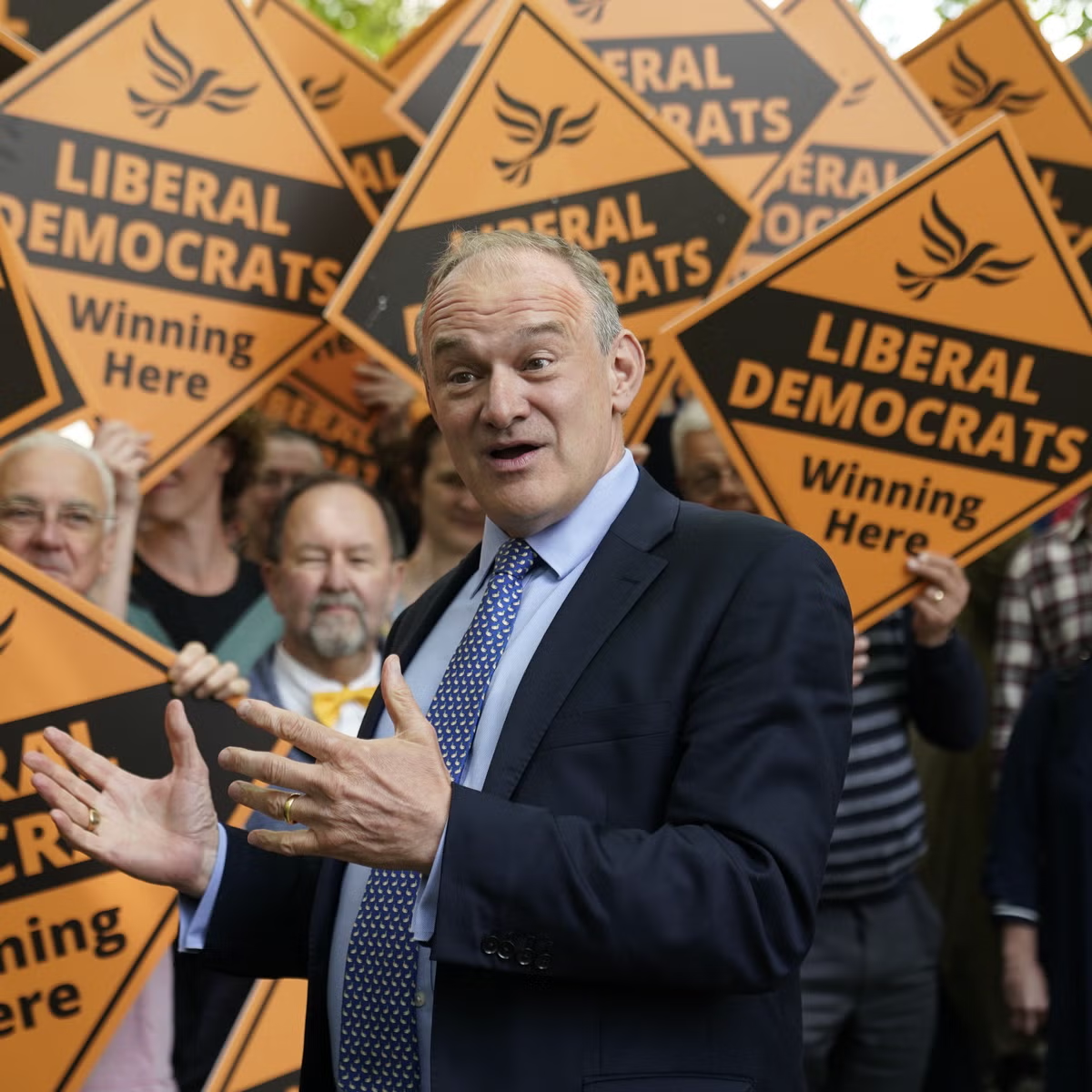
This is the midpoint in a series looking at the challenges and opportunities for the 7 main Great Britain parties. Today we will look at the Liberal Democrats and see if they can continue their recent triumphs.
Understanding the LD’s success
2024 was the most successful election to date for the LDs in terms of seats won and their ratio of seats to votes was twice as high as their previous best of 2005.
| Election | % of Votes won | % of Seats won | Ratio seats to votes |
| 1992 | 17.8% | 3.1% | 0.17 |
| 1997 | 16.8% | 7.0% | 0.42 |
| 2001 | 18.3% | 7.9% | 0.43 |
| 2005 | 22.0% | 9.6% | 0.44 |
| 2010 | 23.0% | 8.8% | 0.38 |
| 2015 | 7.9% | 1.2% | 0.16 |
| 2017 | 7.4% | 1.8% | 0.25 |
| 2019 | 11.6% | 1.7% | 0.15 |
| 2024 | 12.2% | 11.1% | 0.91 |
The reason for this is that there have been 2 different phases of evolution of the party. Emerging from the Liberal-SDP Alliance, the Lib Dems became the none of the above party for those voters who didn’t like either the Conservatives or Labour. This allowed the Lib Dems to get a substantial vote share in 2005 and 2010 in a wide-range of seats, although without gaining the number of seats they would under a PR system.
In 2010, the LDs joining the Coalition led to half of their vote deserting them within a year.
The Brexit vote and Conservative woes allowed the LDs to attract a new type of voter. We can draw a pen portrait of this type of voter as follows:
White, Middle aged, Middle class, lives in a leafy town or suburb, voted Remain, shops at Waitrose.
Targetting these voters allowed the LDs to pick up a large number of seats with a very efficient share of the vote. The new challenge is that this pool of voters is already close to being tapped out. There are now only 11 seats where the LDs are within 5% vote margin. Of these 10 are Conservative marginals of a similar type (including Jeremy Hunt’s seat, which was a near miss in 2024.)
After that, it gets much harder. Seat no. 12 is Salisbury where the LDs were third in 2024 and no. 20 Montgomeryshire, they were fourth.
Often the new target seats have pockets of LDs, but also voters with unfavourable demographics.
30 – Leicester East – too ethnically diverse
40 – Isle of Wight East – too many pensioners
59 – Preston – too working class
71 – Durham North – too Brexity
Looking at Preston council area as an example, in the May council elections, the LDs won 3 suburban and rural divisions and narrowly lost a 4th with 1652, 1,601, 1,496 and 1411 votes. However, in the other 5 more urban working class and ethnically diverse divisions they got 578, 242, 204, 186 and 128 votes.
Attracting more voters
The current strategy has been successful but it is going to be hard to turn that into substantially more seats. If the LDs want to become a major party, they need to think about attracting new types of voter and trying to overtake one of the traditional big two.
Many people have said that the LD should try to replace the Conservatives. However, the LDs have already mopped up many of the Cameroon Tories. Therefore, the remaining Conservative voters are likely to be more socially conservative.
The key issue is immigration, where the LDs and their activists have taken a traditionally left-wing position. Are they really willing to move to the right to challenge for Conservative votes?
The other option is to go after Labour. This also isn’t that straightforward. Many Labour voters are economically left wing and the Labour left and the Greens are calling for a wealth tax. Are the LDs willing to consider something like that to attract left wing votes at the expense of potentially upsetting their voters in blue wall seats like Maidenhead?
Playing second fiddle
The danger for the LDs is that if they can’t supplant one of the big two, that they may end up playing second fiddle again.
Currently, the polls suggest a Reform majority but it wouldn’t take a huge swing back (say Lab in the high 20s, Ref in the low 20s) for a hung parliament with Labour as the largest party.
I would argue that in terms of governing, the Con/LD Coalition was a huge success and delivered on its objectives. The problem is that the Lib Dems got badly burned electorally.
They need to start setting a price for Coalition 2.0. Last time, they spent much of their political capital on a referendum on the voting system, which they then lost. The Lib Dems have long been advocates for PR and their seats to votes ratio in the 1990s shows why. Ironically, with the 2024 election, FTFP is finally working for them.
Any coalition would need careful management to keep the blue wall voters happy or the LDs could be back to square one again.
Marmite vs. rice pudding
We often hear politicians described as being marmite – you love them or hate them. I would argue the opposite is being rice pudding – comforting, safe, bland.
What do you remember about the Lib Dem 2024 election campaign?
I remember them winning lots of seats and Ed Davey falling off a paddleboard. What about policies, though?
An astounding fact from the YouGov leader polling posted by TSE on 18th June is that 4 in 10 of the British public have no opinion on Ed Davey whatsoever, despite him being leader for 5 years (by contrast only 9% have no opinion of Farage and 10% have no opinion of Starmer).
The downside of being a rice pudding party is that while you aren’t hated, indifference doesn’t drive people to the ballot box. How the LDs overcome this is by using their army of activists to work target areas, but in the LD “deserts” it makes it very difficult to break through, when you don’t necessarily have a local councillor base.
National vs. local
One of the things that struck me is that in the 2024 local elections the LDs got a NEV (national equivalent vote share) of 17% but at the general election a couple of months later they got 12%. There are a couple of potential reasons for this:
- Differential turnout – Lib Dem voters are more likely to turn out at local elections than other parties’ voters.
- There are a cohort of voters who are happy to vote for their nice local councillor who gets potholes fixed but aren’t willing to vote for the national party/
Beware the Zeitgeist
The LDs had a fantastic campaign last time, so same again but bigger and better? Get Ed Davey bungee jumping in Ironbridge Gorge or dressing up as a caveman at Stonehenge. I’m not so sure.
At the last election, the overwhelming desire of the British public was to stop the Tory chaos. This benefited Sir Keir Starmer as a perceived safe pair of hands but also helped the Lib Dems.
Next time, it’s a shaping up to be a different mood. Much of the public seem to be furious about the status quo and therefore, there will likely be more appetite for taking a risk.
I looked at the LDs’ 2024 manifesto and a it felt like tinkering around the edges – a new law on puppy smuggling, a new quango on women’s justice, naming and shaming banks. I’m not saying these are bad things but I didn’t get the impression there were any really transformative ideas or any recognition that the system as a whole may need to change.
The danger for the Lib Dems is that they are perceived as another party of the status quo and that if the British public are looking for change, they may turn to more radical parties like Reform, the Greens or a new Corbynite party instead.
Next time – the SNP
Gareth of the Vale