Analysing the September 2025 YouGov MRP
Last week YouGov released the latest iteration of their MRP (Multi-level Regression and Post-stratification) survey. For anyone not aware, this is a survey combining data from 13,000 voters and demographic data to predict all the seats in Great Britain (except for the Speaker’s seat of Chorley).
YouGov have had splendid success with their MRP and correctly called 92% of seats at the 2024 election (also helping my betting returns).
That said, we should point out a couple of caveats as highlighted by TSE:
- MRP surveys are less accurate the further away from the election they are.
- MRP surveys sometimes underestimate independent candidates (as at this stage they ask about parties rather than individual candidates).
Nevertheless, setting aside these caveats, the YouGov MRP shows some potentially fascinating trends.
Overall results
YouGov’s overall results show Reform just short of a majority. They base this on a vote share of 27%, which is lower than Reform’s national polling average of around 30%. Conversely the LDs are slightly higher than their national polling average.
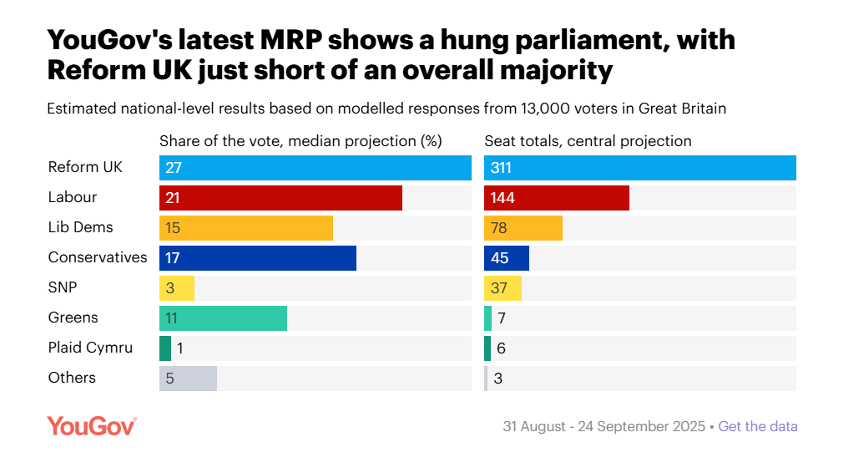
YouGov September MRP
Safe, solid and lean seats
I went through the YouGov raw data and assigned each seat to a category:
Safe – The 1st place party is 21% or more percentage points ahead of the 2nd place party
Solid – The 1st place party is 11-20% percentage points ahead of the 2nd place party
Lean – The 1st place party is 6-10% percentage points ahead of the 2nd place party
Toss up – The 1st and 2nd place parties are within 5% or fewer percentage points of each other
Based on this I created the following table:
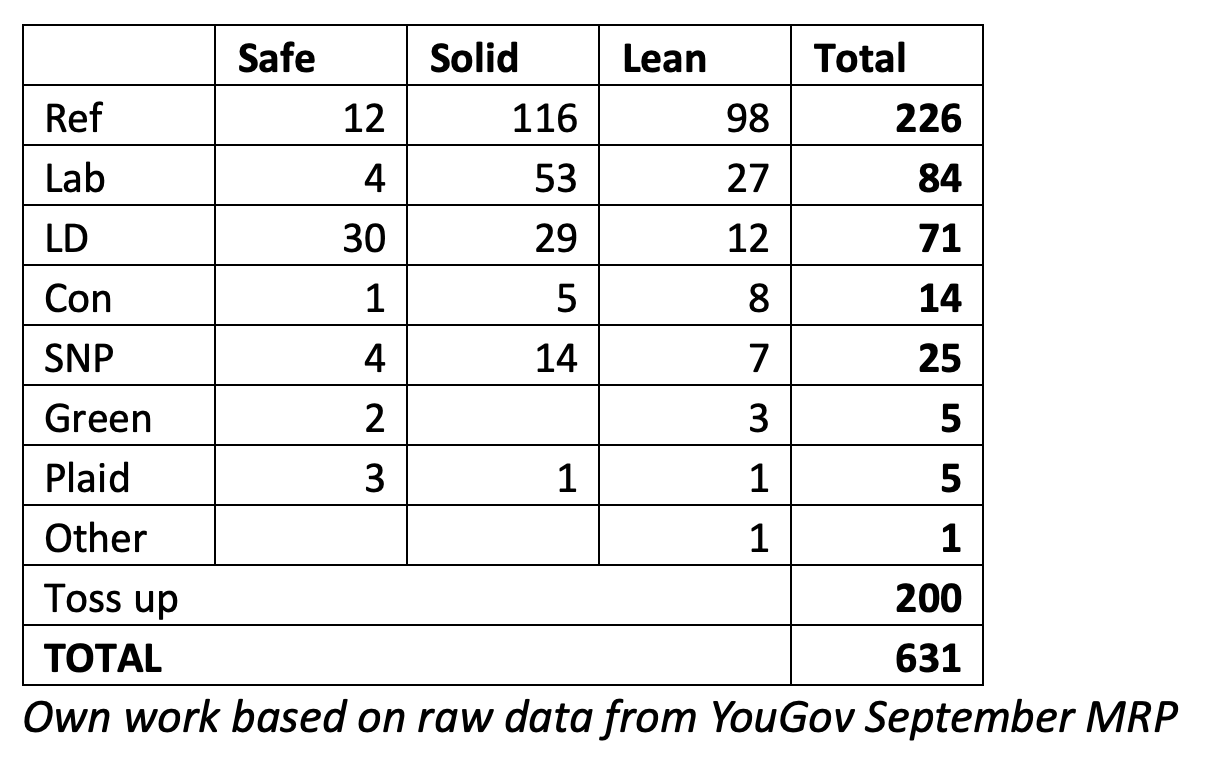
Almost a third of seats are in the toss up category, which shows that the next election is still very much in the balance.
Reform are assigned “safe” seats than the 5 they won in 2024. This reflects the fact that in seats like Sittingbourne & Sheppey, SW Norfolk and Cannock Chase, Reform are so far ahead that the incumbent Labour MPs already look doomed. While they are currently well placed, Reform are not shoe ins to win power. They look likely to gain seats even if there is some swing back, but if they ended up with just the 128 safe and solid seats that would be a huge disappointment for them from the current polling position.
Labour have a core of 57 seats centred on London and Merseyside. Two of Labour’s safest seats, Dulwich & West Norwood and Croydon West, have significant numbers of black voters suggesting this group of voters is less concerned about issues such as Gaza. The overall situation should be very worrying for Sir Keir Starmer as 7 out of 8 Labour MPs are currently vulnerable.
The Lib Dems have the most “safe” seats of any party. In part, they are benefitting from a Conservative to Reform swing, making many of their seats safer. For example, Surrey Heath was LD 45%, Conservative 33%, Reform 13% at the election, while YouGov are now predicting LD 41%, Conservative 23%, Reform 23%.
The Conservatives only have 6 safe and solid seats. Of these 3 (Harrow East, Ruislip, Northwood & Pinner and Leicester East) have significant numbers of Hindu voters, while Hertsmere has a significant number of Jewish voters. The Tories have major issues as around a sixth of their current seats are already looking solid for Reform, e.g. Louth & Horncastle Reform 42%, Conservative 25%, and another sixth are leaning Reform.
The SNP should increase their seat count, but have some work to do to monopolise as they did in 2015 and 2019.
Breakdown of the toss up seats
I further broke down the toss up seats. This analysis is separate for England, Scotland and Wales
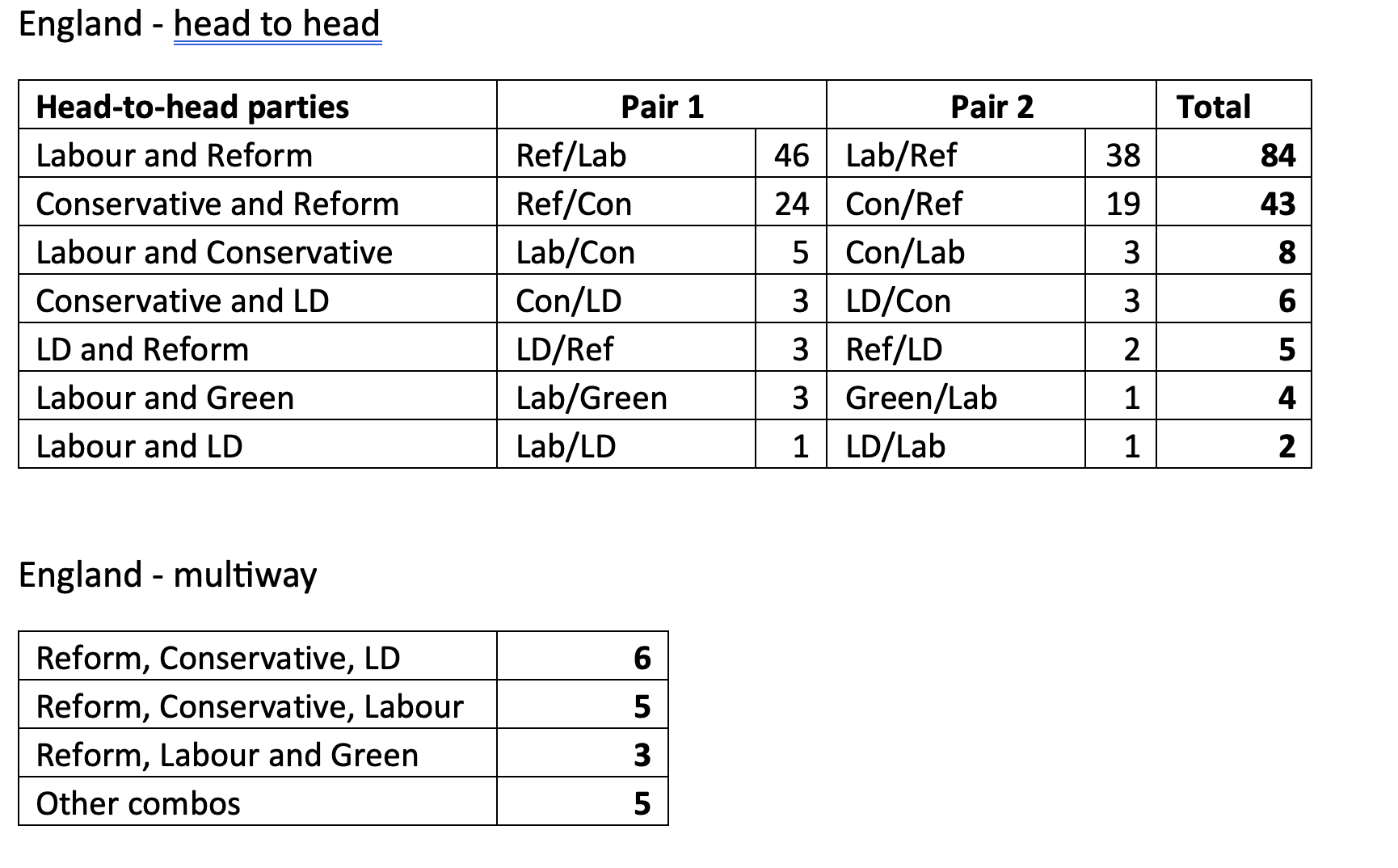
The traditional battles in England have been Conservative vs. Labour and Conservative vs. LD, but neither look set to be the main contests going forward. The remaining Lab/Con contests tend to be in London where Reform is weaker, e.g. Hendon, Kensington & Bayswater. Instead, the main contests look set to be Reform vs. Labour and Reform vs. Conservative.
The dog that hasn’t barked to date is Labour vs. Green. The Greens’ polling has increased, and they are getting a lot of solid second places but not yet getting close enough, e.g. Lewisham North is Labour 41%, Green 25%. It will be interesting to see what happens when Corbyn’s outfit finally gets going.
The multiway contests tend to be traditional Conservative seats like West Worcestershire, where a split right-wing vote is letting a left-wing party in or traditional Labour seats like Birkenhead, where a split left-wing vote is letting a right-wing party in.
Scotland – head to head
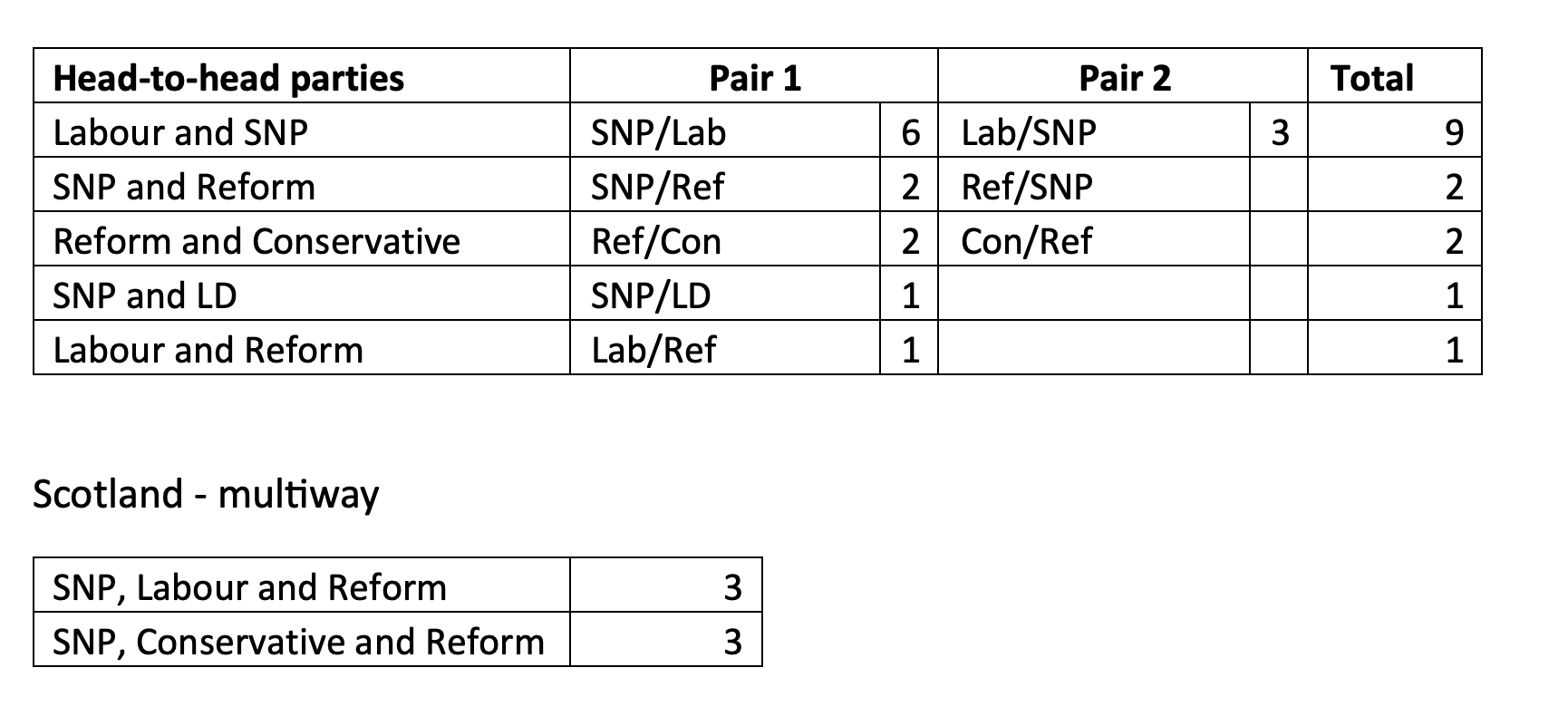
The main head-to-head contest in Scotland remains SNP vs. Labour, particularly in the large urban areas. Outside this Reform is threatening the Conservatives’ 5 seats but also making headway in Ayrshire and the North East. One interesting contest is Gordon Brown’s old seat of Kirkcaldy & Cowdenbeath, which YouGov have as Labour 27%, SNP 25%, Reform 23%
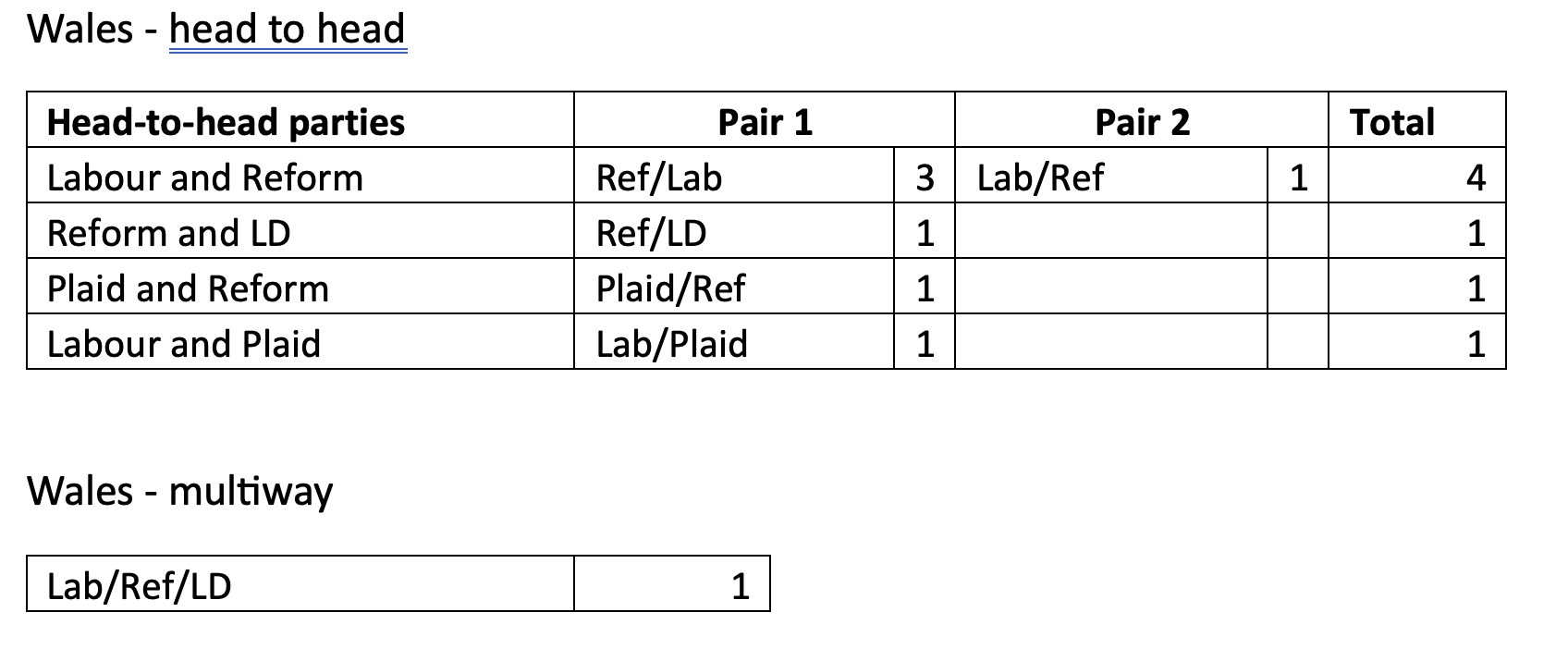
The key takeaway from Wales is that only 8 of its 32 seats are currently tossups. Currently, YouGov has 11 Solid Reform and 8 Lean Reform seats. The 3 seats that Labour currently lead (all in Cardiff) are only tossups so astonishingly they are in danger of a complete wipeout. Perhaps equally surprising is that the traditional opposition party, the Conservatives, are doing even worse and are not even second in any seat (their highest vote share is 20% in Monmouthshire). The upcoming Caerphilly Senedd by-election will give us a pointer, but the future of Welsh politics could be Reform vs. Plaid.
More in Common MRP
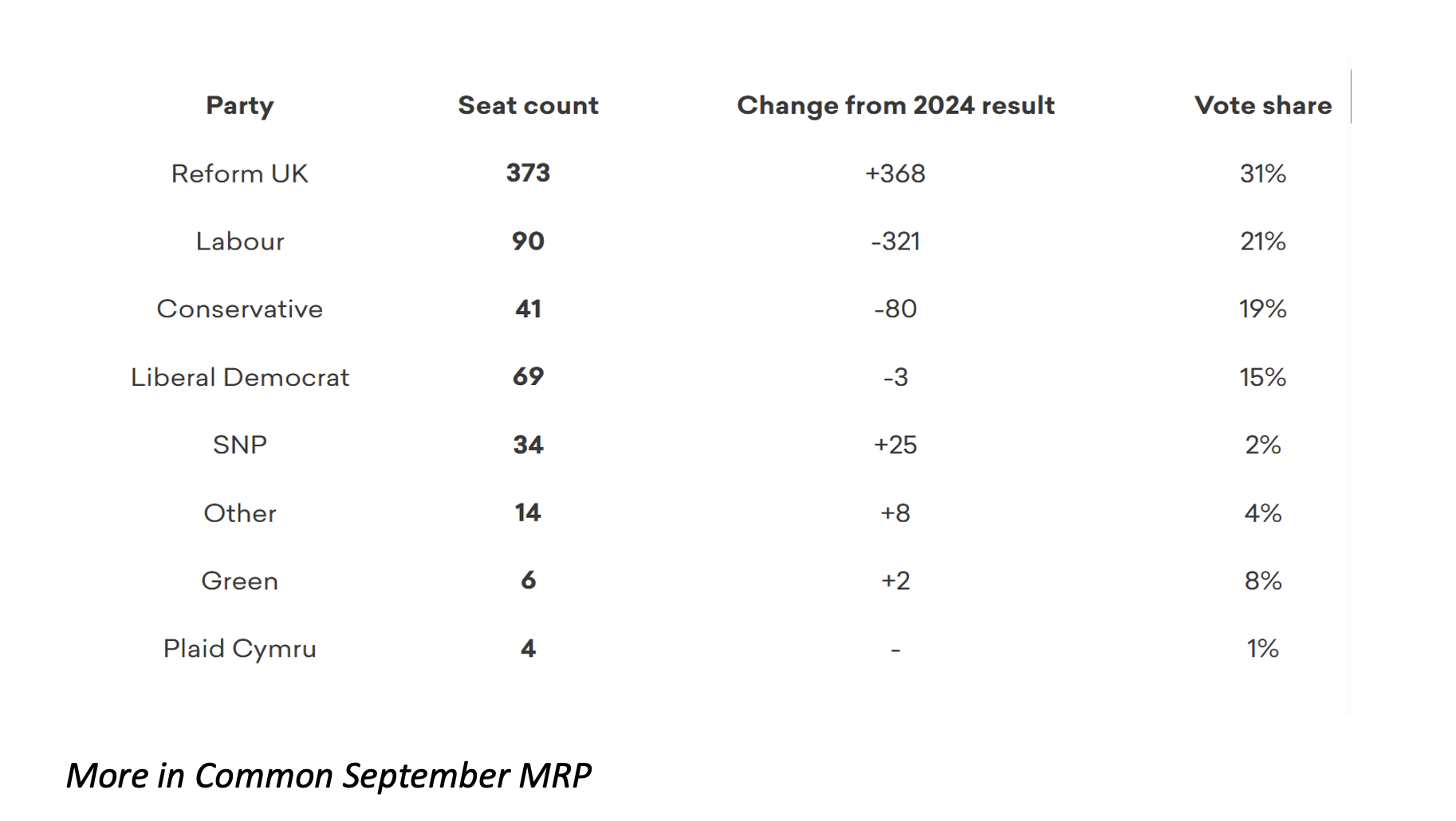
More in Common have also just released an updated MRP as well. They have a higher Reform vote share and more Reform gains from Labour but are fairly consistent on the other parties and similar for most individual seats.
Conclusion
It’s still likely 4 years to the next election but the portents are already grim for both Labour and the Conservatives.
Labour are up against it in pretty much all of their traditional heartlands apart from London and Merseyside. Both MRPs have Reform winning urban seats such as Newcastle Central and West, Leeds East and Nottingham North & Kimberley, as well as the Welsh Valleys, where Boris simply couldn’t reach. And this is before Jeremy Corbyn gets going.
The Conservatives’ problem is that 2024 was their worst ever election and they still haven’t hit rock bottom. Their pensioner base seems to be deserting them for Reform (Christchurch has the most over 65s in the UK at 35% of the electorate and has gone from Conservative 36%, Lib Dem 20%, Reform 19% at the election to Reform 36%, Conservative 22%, Lib Dem 22% in the YouGov MRP.) While Hindu and Jewish voters seem to be staying loyal, neither demographic group is large enough to sustain a national party.
Reform’s upward momentum looks set fair to continue into next year and beyond. However, the number of toss up seats should give them cause for concern as they are still vulnerable to swing back or tactical voting. The elections next year will be fascinating as Reform will need to create Scottish and Welsh manifestos, which will be scrutinised closely.
The Lib Dems are not necessarily making a lot of gains, but they look very well established in their current seats. In a Reform landslide scenario, it’s not out of the question that 70-80 seats could leave them as the main opposition party.
Final thought – spare a moment for the electors of Watford and their letterboxes. Both MRPs have this seat as a 4-way fight between Reform, Lib Dems, Conservatives and Labour.
Gareth of the Vale