The challenge for the Conservatives

Hitting rock bottom
The Conservative party is the oldest and most successful party in UK history. The 2024 election was the worst ever in its long history (the previous worst in 1906, they still held on to 156 seats)
In theory, the Conservatives are still well placed as there are 227 seats, where the required swing is less than 10%. However, it’s not proving remotely easy so far.
With Labour seeing their popularity dwindle, the Conservatives ought to be the natural beneficiaries, but instead they have slipped back further as Reform have surged.
Wasted vote syndrome
In the past, the Conservatives have been able to say that votes for Reform (and predecessor parties) were a wasted vote. However, if the current polls persist, there is a point at which this can be turned back against them.
For example, in Bracknell, who is best placed to get rid of the Labour MP?
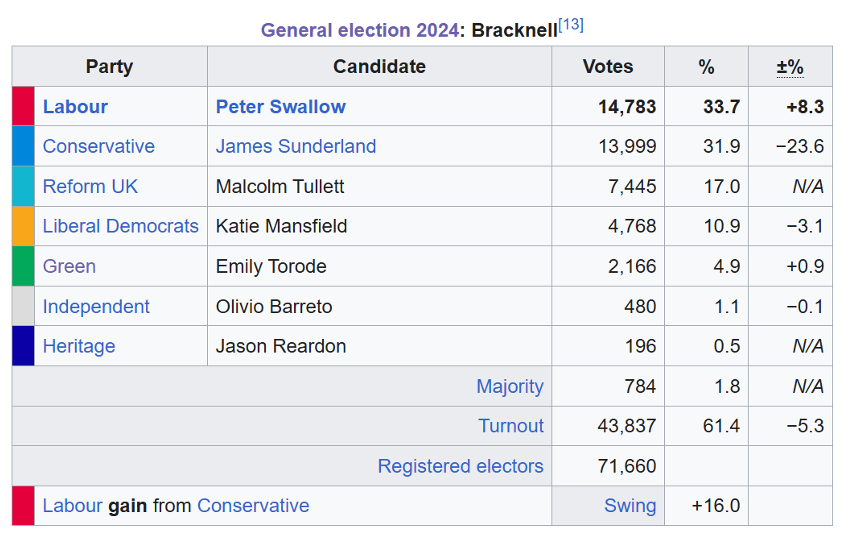
Bracknell 2024 election result: source Wikipedia
The answer ought to be the Conservatives. However, the Feb 2025 YouGov MRP had Reform 28%, Conservative 25%, Labour 25% and the polls have got worse for the Conservatives since then.
A toxic legacy
I would argue the biggest issue is that in 1997 the Conservatives were tired and sleazy, but they could still point to a robust economy and the legacy of Mrs Thatcher’s reforms. Today, what do the Tories have to show for 14 years? In fairness, they did have some successes but these are now outdated or controversial with parts of their base:
Outdated: balancing the books after the financial crash, vaccine rollout
Controversial: Gay marriage, Net Zero
And of course there is Brexit. Remainers feel this was a mistake. Brexiteers feel it was only half done.
Immigration
The Conservatives’ legacy is even more damaging as it casts a long shadow over current policy, the biggest example being immigration. What can the Conservatives possibly say on this topic? They repeatedly promised to reduce immigration to the “tens of thousands” and failed to achieve that.
Any new promise will be met with the question “why didn’t you do that in 14 years?” But if the Tories don’t promise to reduce immigration, how can they then fight Farage?
What the Tories desperately need is for Labour to reduce the numbers, so that come the next election the main issue is something else (preferably the economy)
Opposition vs. the opposition
All parties oppose the government but there are enormous advantages to being the official opposition.
In parliament, the main opposition gets 6 questions each week at PMQs and they get to chair select committees.
In the media, they get a televised response to every government policy. They get stand-alone election debates vs. the governing party.
The existential threat is not necessarily from Labour. The Conservatives can be walloped again, but still come back, as long as they retain second place. If they drop out of the top 2 though, then it’s game over.
The talent pool
Both 1997 and 2025 were drubbings, but 2025 was much worse. In 1997, the party still retained 164 MPs; in 2025, it was only 121.
This has led to a draining of the party’s talent pool.
Those who were kicked out by the electorate, like Penny Mordaunt
Those who jumped before they were pushed, like Michael Gove
Those who could have held on but chose to quit, like Sajid Javid
Mordaunt, Greg Hands, Liam Fox and Mark Harper are all former ministers who lost by less than 1,000 votes.
The knock-on effect is that the shadow cabinet mostly consists of solid second stringers like Chris Philip and Claire Coutinho or retreads like Priti Patel.
The next leader
You don’t have to be Nostradamus to foresee the short-term future for the Tories. The 2026 elections are likely to be bad for them, and the MPs will then start writing their letters to the 1922 Committee.
The problem is whoever comes next (most likely Cleverly or Jenrick) is going to face exactly the same situation as the voters are punishing the party for their 14 years in government, rather than Kemi Badenoch personally.
Brand loyalty
Labour has always benefitted from tribalism of the “my family have always voted Labour, and I’ll always vote Labour variety.”
The Left also often value ideological purity over winning. For the Right, it’s the opposite. If the Tories can’t win, then what good are they to their supporters?
The moment of maximum danger will be if a new leader still can’t turn it around. At that point, many will start questioning whether the party can ever recover, and the Tory rats may start to leave the sinking ship (defecting to Reform as we have seen with Kruger or perhaps the LDs.) Some may instead retire or start lining up jobs outside politics.
And there’s also the donors. Labour have the Unions on their side (mostly). The Tories have always had to rely on wealthy donors, who a cynic might say are looking for something in return. If the Tories aren’t in power, how can they keep these donors sweet?
Series conclusion
Let me finish with 3 dates:
7th November 1917
26th December 1991
23rd June 2016
The first date is the start of the October Revolution (it actually started in November, but Tsarist Russia still used the Julian calendar). For me, this marks the date when politics became economics. What I mean by that is that people tended to vote by social class. The workers voted Labour, while the middle class voted Conservative.
The second date is the dissolution of the Soviet Union. This marked the end of the Cold War and the start of globalisation. This also then unlocked a period where many old working-class jobs disappeared, although services flourished.
The third date is the date of the Brexit vote. In a UK context, this marked the start of a return to politics as culture (arguably this started earlier in the US with the Tea Party). Politics as culture is actually not that unusual in a UK context. The religious wars of the 15 and 1600s were really just culture wars by a different label. Protestantism started out as the religion of the urban elite, while the periphery clung to their traditional Catholicism.
If 2016 marks the start of a new era, then all the parties will need to adapt or die.
Some people have suggested our politics may end up becoming more American. I would suggest we should look across the Channel instead.
In France, a right-wing President Nicolas Sarkozy lost office to a left-wing President François Hollande who also failed. This then led both the traditional parties to wither away, with a new centre party facing off against both the hard right and hard left.
How could this happen in the UK? Consider the following scenario:
Rachel Reeves presents her autumn budget but the markets react badly and UK bond rates soar. Starmer fires Reeves and brings in a new chancellor, who presents an austerity budget with severe cuts. However, left-wing MPs rebel and the budget is voted down. With bond markets soaring, Starmer now has no choice but to kick out the rebels and form a Government of National Unity with the Conservatives and Lib Dems. Stability is restored for the remainder of the parliament, but the 3 governing parties slump in the polls to Reform and the Corbynite left. As a last roll of the dice they bring in AV before the 2029 election.
Maybe it sounds far-fetched, but the fault lines are there: on the left between the fiscal realists and full-fat socialists, on the right between those who prioritise stopping immigration and the defenders of international law.
There is an apocryphal Chinese curse: may you live in interesting times. Well, the next few years will certainly be that!
Gareth of the Vale
Previous articles:
https://www1.politicalbetting.com/index.php/archives/2025/06/02/the-challenge-for-labour/
https://www1.politicalbetting.com/index.php/archives/2025/06/12/the-challenge-for-plaid-cymru/
https://www1.politicalbetting.com/index.php/archives/2025/06/21/the-challenge-for-reform-uk/
https://www1.politicalbetting.com/index.php/archives/2025/07/11/the-challenge-for-the-liberal-democrats/
https://www1.politicalbetting.com/index.php/archives/2025/07/22/challenge-for-the-snp/
https://www1.politicalbetting.com/index.php/archives/2025/09/08/the-challenge-for-the-green-parties/