Rage against the machine – charting the rise of outsider parties
A moment I remember from the 2015 election is when a TV interviewer was asking a series of vox pops and one respondent replied he was deciding between UKIP and the Greens.
I recall this as we tend to think of politics as being organized along two axes: one economic, between capitalism and socialism, and the other cultural, between Remainers and Brexiteers.
I would argue for a third axis of insider vs. outsider parties. I would define these as follows:
Insider parties – parties that work within the existing political system.
Outsider parties – parties that seek systemic change.
We can also think of this by referring to the Overton Window. The insider parties operate within the window of currently acceptable elite opinion, while the outsider parties are more likely to have views which may be considered “heretical.” Please note that some of these outsider policies may be unacceptable with the elite but acceptable to the public (for example, a YouGov poll from November showed 50% of the public support bringing back capital punishment, while few in the elite would support that.)
A recent history of outsiders
In the 2000s, there were few votes for outsider parties. The LDs took an outsider position on Iraq, but it would be hard to call them an outsider party.
This changed in the 2010s. First, there was the close call in Scotland 2014, then in 2015 the rise of UKIP (13% in the UK) and the SNP (50% in Scotland). 2016, saw a shock victory for the outsider cause of Brexit, before 2017 saw an outsider, Jeremy Corbyn, leading an insider party. It would be hard to call Boris Johnson an outsider, but the Brexit battles allowed him to run an outsider campaign.
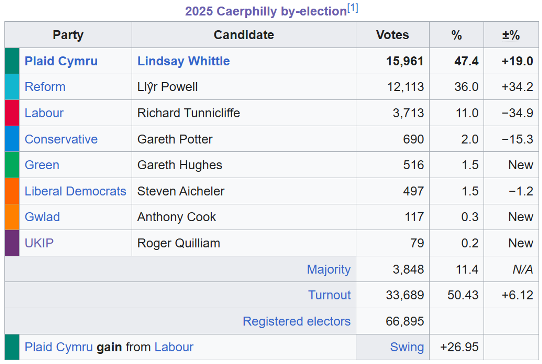
Even in 2024 the outsider parties received around a quarter of the vote combined. On current polling the outsider parties are now over 40% and the Caerphilly Senedd by-election saw an unprecedented battle between two outsider parties, with the 3 insider parties getting less than 15% of the vote combined!
So why is this happening?
I would argue there are 3 main factors:
- It’s the economy, stupid. The period from 1985 to 2007 saw constantly rising living standards. From 2007 onwards, GDP per capita has flatlined, and we now face a situation where debt is high, taxes are high, while public services are struggling.
This has allowed outsider parties to push narratives as to where the fault lies:
The problem is immigration (the right)
The problem is the rich (the left)
The problem is Westminster/the English (SNP/Plaid)
All these narratives have some elements of truth. Is it right to spend billions on migrant hotels for unskilled immigrants when British people are struggling? Isn’t the lesson from the financial crash that casino capitalism comes down to heads I win, tails I get bailed out? And doesn’t the fate of Crossrail vs. HS2 show that Westminster only cares about London and the South East?
- A lack of accountability. If I were to say the words “Duck Island,” most of you instantly know what I’m referring to. The expenses scandal had a corrosive effect on trust in politicians. Not just that some politicians stole from the taxpayer, but because the politicians created a set of rules legitimizing the theft.

Sir Peter Viggers’ Duck Island
We see scandal after scandal, and the politicians keep uttering the same trite phrase, “lessons will be learned”. The public want to see people being actually held to account.
After the collapse of RBS, Fred Goodwin lost part of his pension, but I doubt he is living in a council house. Paula Vennells of the Post Office handed back her CBE in 2024, but she was only awarded it in 2019, well after the scandal was known about.
The last attempt I can think of to actually punish someone was Baby P. Ed Balls fired Sharon Shoesmith, the head of Haringey social services in 2008, but she was able to win a 6 figure payout on appeal in 2011.
3) The fraying of social bonds. It’s often said that PBers are mainly middle class. Here is a question – how many friends do you have who could genuinely be considered working class? Probably not that many, if any. The UK has always had a class system but historically this was largely centered on local villages due to limited travel. With the rise of air travel, the internet, and English as a world language, it is now easier to travel and interact with people in other countries. This has led to what Theresa May dubbed “citizens of nowhere”. I would argue that many UK elites now find it easier and more enjoyable to interact with elites in other Western countries than with working-class Brits.
This has created a divide in understanding between the classes. If we go back to Brexit, the Remainers’ reasoning for why this happened was because Brexiteers were stupid and gullible, but is this really true about 17 million people? For a country that loves long-winded public inquiries, the ones we haven’t had are on Brexit and Scotland. What made the public reject the status quo on Europe and nearly reject it on the Union? Without understanding the underlying causes, why shouldn’t history repeat itself?
Implications for the parties
Part of Sir Keir Starmer’s problem in my view is that he looks like an elitist. A knight of the realm, KC and former DPP, you can’t get more of an insider. And things like the Chagos Islands handover are elite concerns. I think Labour should replace Starmer with Angela Rayner, as she is the only one who could really shake up perceptions.
The LDs have a similar issue in that Sir Ed Davey again looks like the consummate insider. I would also point to his questions at PMQs, which tend to be variations of Brexit=bad, Trump=bad (both appealing to elite concerns).
The Conservatives are in the most interesting position. They have started to take some more outsider positions, such as leaving the ECHR. The problem is that right wingers are suspicious of their motives. As an aside, I think the recent defections have been disastrous for the Conservatives, as they can’t win another majority without squeezing Reform back down.
The outsider parties can ride the zeitgeist at the moment but will still need to ensure the voters don’t get cold feet. Candidate vetting will be key as this damaged Reform in 2024.
What if an outsider party wins?
So, what if Farage or Polanski actually wins? I would expect 3 possible outcomes based on how the Trump presidency has played out:
- The blob fights back. Reform/Green are unable to make the system work and the Civil Service are able to stymie/delay key policies, leading the party to be removed from power by the voters and one of the insider parties returning.
- Reform/Green are able to radically transform the country and make the elites bend to the Government’s will (see what has happened with the US tech sector under Trump v2)
- Reform/Green reach a modus vivendi with elites and become an insider party.
If Polanski wins, I would expect the key battles to be with the Treasury and the markets. If Farage wins then the biggest showdowns are likely to be fought in the courts and the Lords.
What happens next?
The PB consensus tend to be that while the electorate may flirt with parties like Green and Reform, that come the next GE they will (perhaps begrudgingly) return to the traditional big two. I’m not so sure. Let’s not forget that 52% of the electorate voted for Brexit and 40% voted for Corbyn in 2017. The key calculus here is risk vs. reward. If people are happy with the status quo, then they are unlikely to take a punt, but if they feel that Britain is broken, then what have they got to lose?
Ultimately, the insider parties may need to use the Di Lampedusa strategy: “If we want things to stay as they are, things will have to change.” Essentially, that means compromising with the electorate and ruthlessly focusing on the things that the voters see as broken (rather than worrying about peripheral issues like assisted dying or Chagos).
Gareth of the Vale