The challenge for the… Green parties
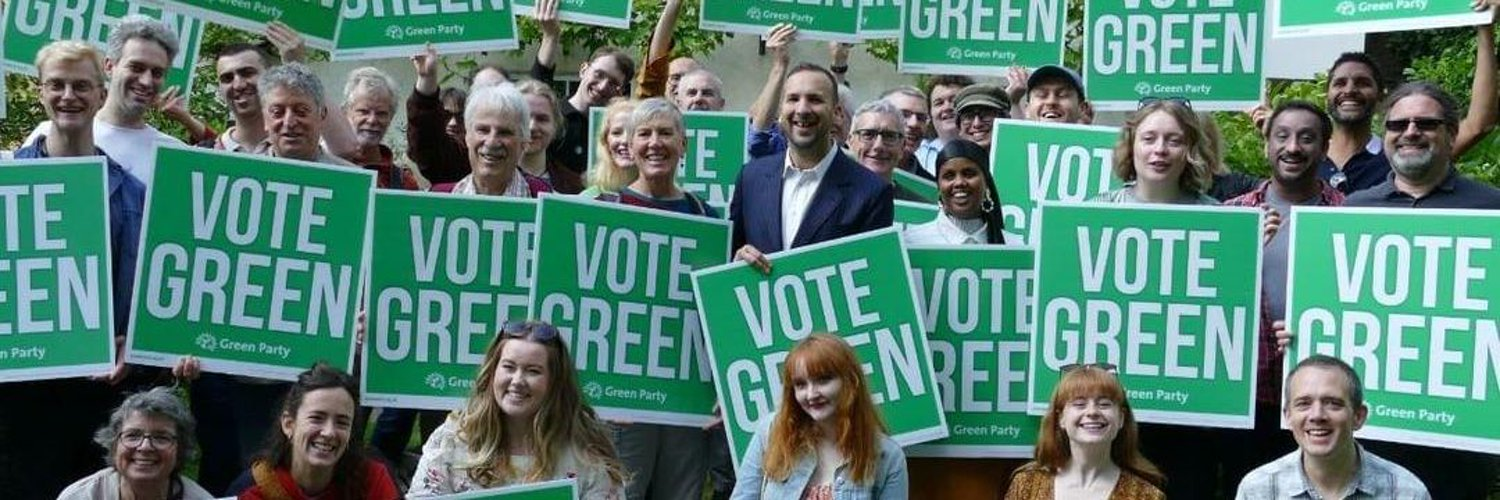
This is the penultimate in a series looking at the 7 main Great Britain parties. The main focus will be on the Green Party of England and Wales, but we’ll also look at the separate Scottish Greens.
Let me start with a question. Since 2010, the Green Party of England and Wales has had 7 leaders or co-leaders, how many can you name?
Vote share
The main challenge for the Green Party in England and Wales is simple: national vote share. In 2024, they got 6.4% of the vote and won 4 seats, which was actually an excellent result as Reform won only one more seat with over double their vote share.
The problem for next time is that they only have 4 target seats within a 10% swing: Huddersfield, Isle of Wight East (from 3rd place), Bristol East and Bristol South.
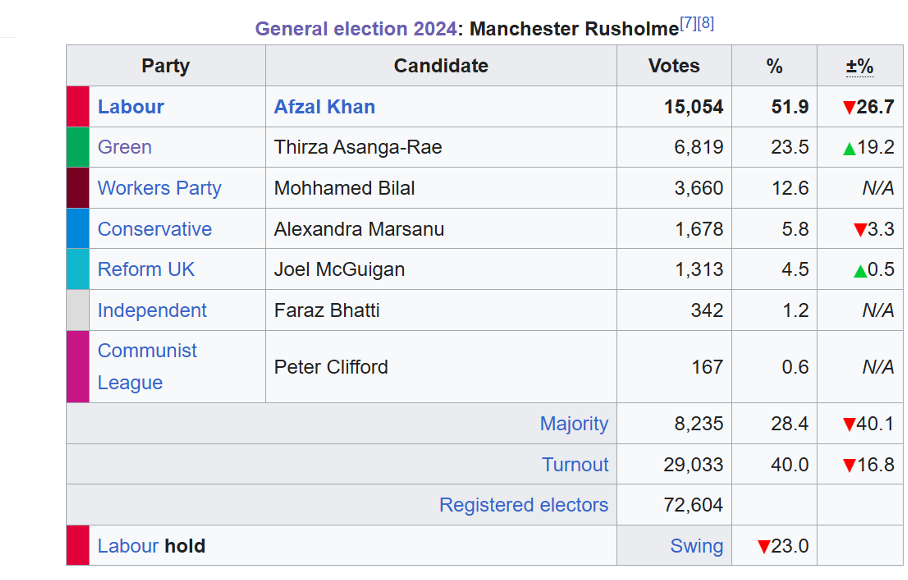
2024 election result Manchester Rusholme – source Wikipedia
If we look at the Green’s 20th target seat, Manchester Rusholme, as an example, the Green Party had a respectable result, coming 2nd and getting nearly 7,000 votes, but they were still a further 8,000 votes behind Labour.
With Labour far ahead, it is not sufficient for Labour to lose votes; the Greens also have to pick them up. The YouGov MRP from Feb 2025 showed Labour dropping from 52% to 41% but the Greens only increasing from 24% to 27%. Currently, the Greens aren’t picking up enough of the votes that Labour are losing.
If the Greens can’t reach double digits by the next election, they may be seen as a wasted vote and risk being squeezed back down again.
The Greens’ USP
The Green Party was originally founded in 1972 as the PEOPLE party before changing its name to the Ecology party in 1975 and the Green Party in 1985. In 1989 the Scottish party split, and the party reached its high watermark with a 15% vote share in the European elections. This success can be put down to the growing public awareness of climate change.
The problem was that the party’s USP quickly disappeared. The other left-wing parties, all started to champion green policies, and even the Conservatives under David Cameron replaced the Thatcherite torch with a green tree as their logo. In fact, Reform are the only party opposed to net zero.
This means that if you want green policies there is no need to actually vote for the Green Party.
Watermelons vs. Mangoes
When the Greens were running Brighton and Hove, they split into two factions who were dubbed watermelons and mangoes.
The mangoes were green on the outside and yellow on the inside i.e. Lib Dem’s
The watermelons were green on the outside and red on the inside i.e. hard left
This split in the party still persists. In 2025, the party won 4 constituencies. North Herefordshire and Waveney Valley are the sort of places you might expect the Lib Dems to win if the Greens weren’t around. By contrast, Bristol Central and Brighton Pavilion are much more in the watermelon mould.
The Greens need to work out where their niche is. The Lib Dems are already well placed to mop up the mango type of voter. So until recently, it seemed that the Greens’ best shot was to aim left.
The People’s Front of Judea
The hard left has always had the tendency to fragment into a plethora of micro parties with minor ideological differences.
In 2025, the Green Party of England and Wales got 6.4% of the vote. However, independents got 2% (say around 1.5% for the Gaza independents), the Workers Party got 0.7%, the SDP got 0.1% and then at a local level parties standing included TUSC, Socialist Labour, the Communists and the Workers Revolutionary Party – for an entertaining read I would recommend the Wikipedia article on the WRP https://en.wikipedia.org/wiki/Workers_Revolutionary_Party_(UK)
And now we have Jeremy Corbyn’s Your Party (correct at time of writing). This party is an obvious threat to Labour but could also hobble the Greens. The Greens’ targets for the next election are almost all Labour held seats and the risk is that the Corbyn party mops up the Greens target voters and maybe some of their existing voters. The Greens and Corbynites need to find a way to do a deal or they’ll likely both be punished under FPTP.
The charisma challenge
Let’s come back to the question I posed at the beginning. I expect most people remember Caroline Lucas and Natalie Bennett stands out for her car crash interview at the 2015 election. The rest though (Jonathan Bartley, Siân Berry, Carla Denyer and Adrian Ramsay) didn’t really stand out.
While the Greens have long liked co-leaders, I’m not convinced this does them any favours. The challenge for smaller parties is getting attention, and for that you need someone who can grab the llimelight (Farage) or the use of clever stunts (LDs). It will be interesting to see whether Zack Polanski can cut through the political noise.
We know that Jeremy Corbyn can attract attention, and the fact that his fledgling party has already attracted 700,000 sign ups is impressive. If the Corbynite party can poll well they could potentially challenge to join the current 7-party debate format at the next election. If you have an 8 party debate with 6 from the left, the Greens could get drowned out.
The Scottish Greens
The Scottish Greens have different challenges from the English party. The party has never been in contention in the Scottish Westminster seats. However, it is a different story at Holyrood.
The Additional Member System that Holyrood uses means that it is difficult (but not impossible) for the SNP to win a majority, as they dominate the constituencies but rarely win any list seats. Nationalists have realised that the system can be gamed by giving their list vote to the Greens (the only other party who support independence). This resulted in a government in 2021 of the SNP and Greens.
The Greens and SNP agreement fell apart in 2024 apart after Humza Yousef decided to withdraw from it. The challenge now is whether the Greens can continue to rely on SNP second preference votes as they have done before, if they can’t work with the SNP Government.
The wider strategic challenge for the Scottish Greens is that they have become the face of Nicola Sturgeon’s gender reforms and possibly better known for their stance on trans issues rather than Green issues. This may certainly help them with some groups of voters, but makes it harder to break through with the wider electorate.
If the Scottish Greens aspire to greatness, then their position on the constitution means they could only reasonably aim to supplant the SNP. This means trying to outflank the SNP on independence, although Alba and the ISP haven’t managed it. Or the Greens try and rebuild relations with the SNP but then they are always stuck playing second fiddle.
Next time.. The series concludes with the Conservatives.
Gareth of the Vale